
Pallet contents not connected to identity
Products grouped physically onto a pallet may have no shared handling-unit record in software.
Implementation Example
Implementation ExampleHow a persistent pallet identity, RFID tag assignment and enterprise integration come together in a warehouse putaway-to-dispatch workflow.
A representative implementation pattern based on established RFID pallet-tracking workflows, not a named customer deployment.
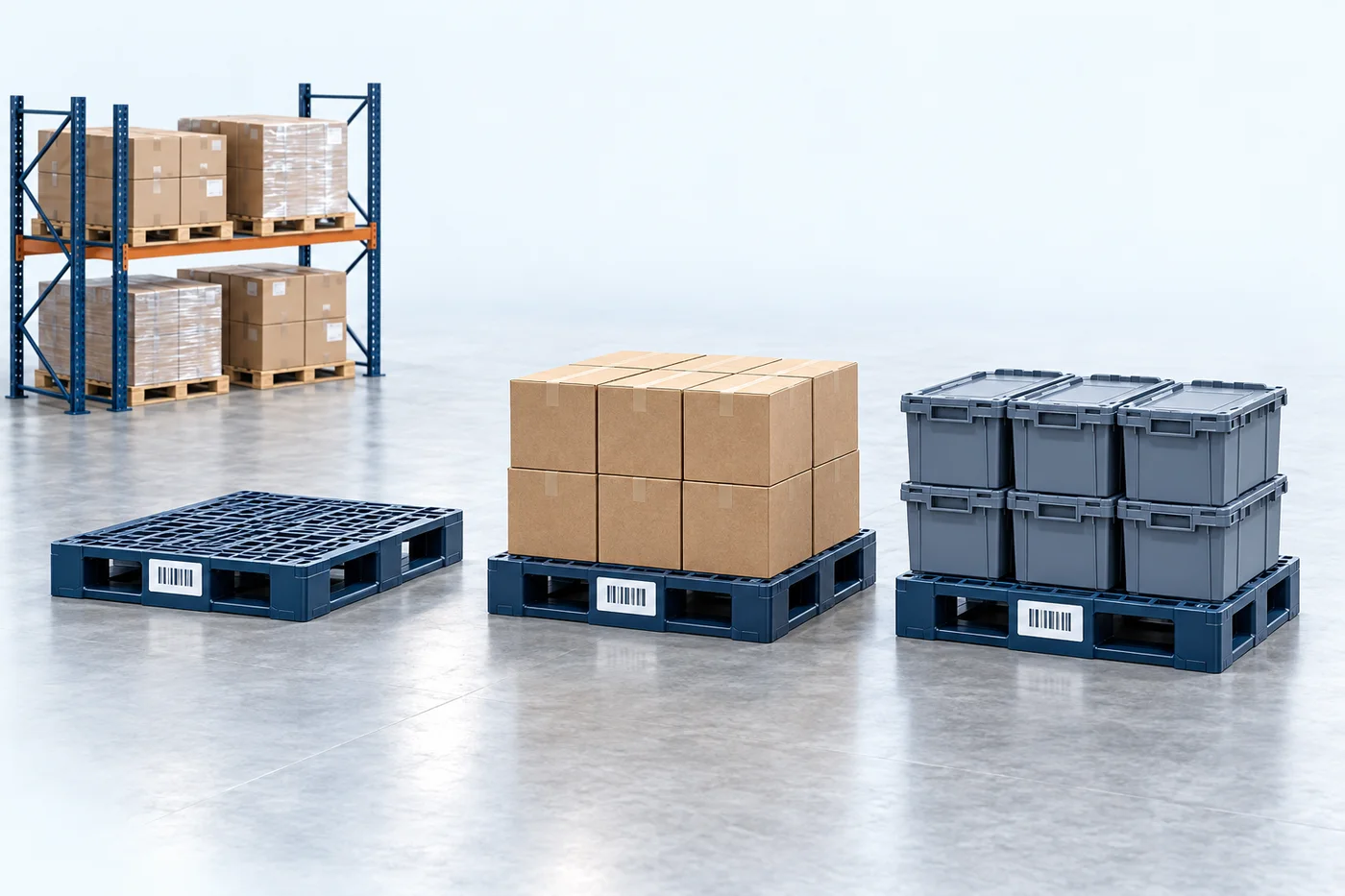
Pallet identity through the warehouse
Pallet lifecycle
Products grouped physically onto a pallet may have no shared handling-unit record in software.
Teams may know a pallet exists without a confirmed, current storage location.
A pallet's current location may be known while the route it took to get there is not.
Confirming a pallet matches an order or shipment can depend on visual inspection rather than a validated check.
Many manufacturing sites already group finished goods onto pallets and record a pallet reference on a printed label or delivery note. That reference is often static: it identifies a pallet at creation but is not consistently updated as the pallet moves through storage, staging and dispatch.
Movement between locations, where recorded at all, may depend on a paper transfer note or a location field updated manually in the WMS or ERP after the fact, rather than at the moment the pallet is actually moved.
Because the pallet is identified visually rather than through a scan or a tag read, verifying that a specific pallet matches a specific order at dispatch also depends on an operator recognizing it correctly or reading a printed label under time pressure.
An identifier that stays unambiguous across the sites and systems involved.
A record connecting the pallet to what it holds, including relevant batch or lot detail.
A controlled way to bind, and where necessary replace, the physical tag associated with a pallet record.
A way to record confirmed storage locations and transitions between them.
A check that compares the pallet being loaded against the expected order or shipment before release.
The approach centers on a pallet record created at the point the physical unit is formed, before it enters the RFID workflow. That record carries the product, batch and quantity association agreed for the operation.
An RFID tag is then bound to the pallet record rather than treated as the source of truth on its own. The tag lets fixed readers and handheld devices identify the pallet without a direct line of sight or a deliberate scan at every step, but the software record, not the tag, remains the authoritative statement of what the pallet contains.
Fixed readers at defined transitions, such as a putaway zone or a dispatch gate, and handheld readers used for search, counting or verification tasks both feed observations into the same pallet-tracking workflow, which applies business rules before treating a read as a confirmed movement.
Individual products or containers are identified before grouping.
A unique pallet record is created in the agreed system of record.
Products are scanned or associated to the pallet, recording quantity and batch detail.
An RFID tag is bound to the pallet record and the association is verified.
The pallet is assigned to a storage location and the placement is confirmed.
Fixed or handheld readers capture subsequent transitions between zones.
The pallet is selected against an order or production requirement.
Identity, contents and shipment association are checked before release.
Confirmed events are posted as business transactions in the enterprise system.
A pallet record that persists from creation through dispatch, independent of any single reader event.
A recorded link between the pallet and the products, batches or quantities it carries.
A sequence of confirmed transitions available for operational review.
A current, confirmed storage location rather than an assumed one.
A checkpoint that compares the pallet against the expected shipment before release.
Confirmed events reaching ERP or WMS as business transactions rather than raw reader data.
RFID read range and reliability depend on tag type, mounting, surrounding materials and reader configuration; they need site testing rather than a fixed assumption.
A tagged pallet moving through a portal can produce several raw reads; middleware needs to group these into one movement event before anything is posted.
Determining direction of travel and excluding reads from adjacent zones usually requires deliberate antenna placement and zoning, not just adding a reader.
These conditions can affect RFID performance and may call for tag selection or placement changes rather than ruling RFID out entirely.
ERP and WMS responsibilities for creating the pallet identity and owning inventory quantity need to be agreed before implementation.
Discuss your workflow
Tell us how pallets are created, moved and dispatched in your operation. We can help evaluate whether RFID, barcode or a hybrid approach fits your workflow.