
Assets difficult to locate
The last recorded location may be outdated or too broad to guide a useful search.
Asset Visibility
Create a digital identity for physical assets and maintain their location, custody and movement history using RFID, barcode and mobile workflows.
CoEnablers can combine fixed RFID infrastructure, handheld readers, barcode labels and enterprise software based on the level of automation required.
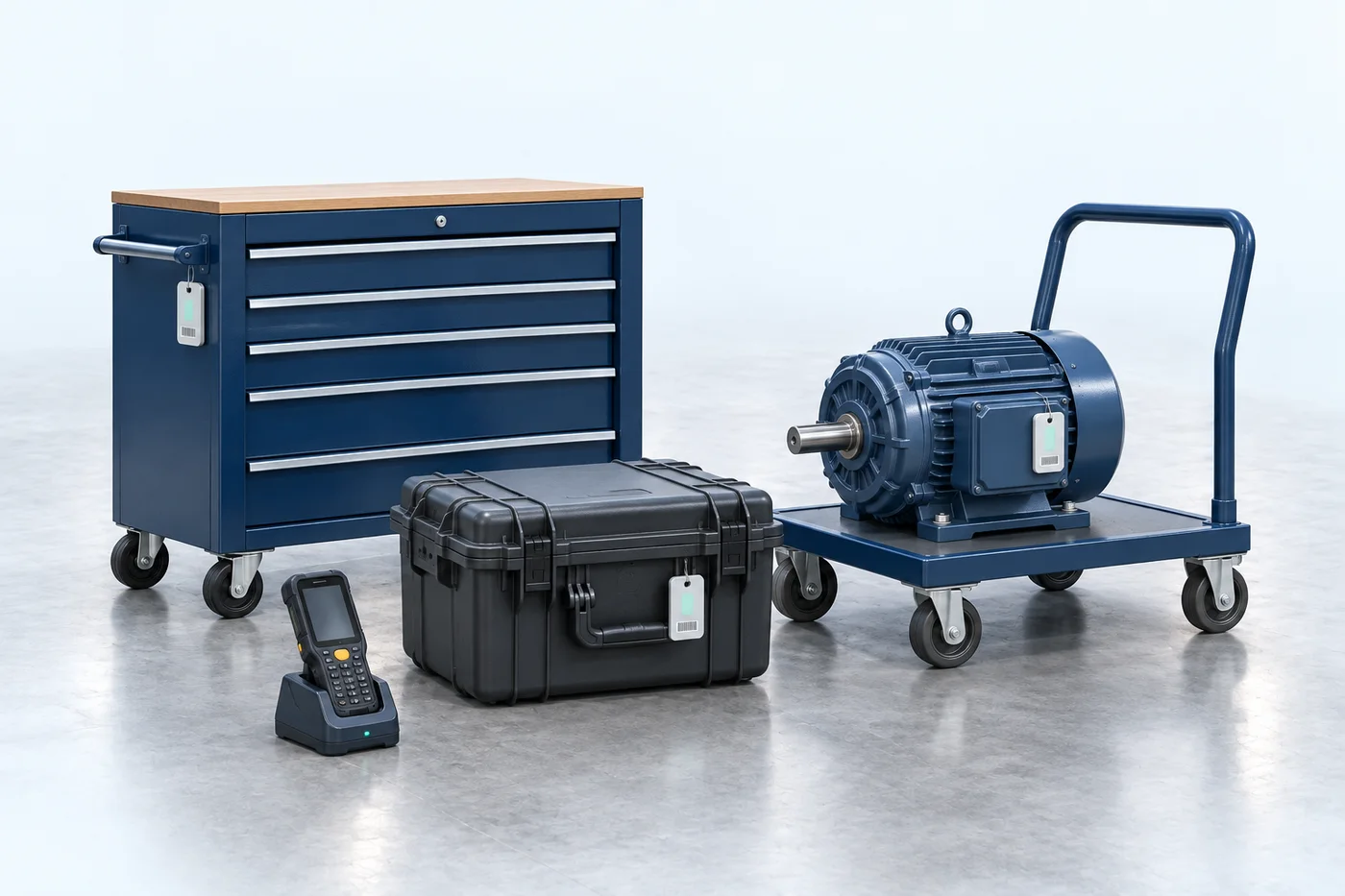
One identity. Connected records.
Asset record
Asset ID and physical tag association.
Last confirmed place and responsible person.
Issue, movement, return and verification.
A tool can change location, department and custodian without becoming a new asset. Its digital identity should remain stable through those changes, linking the current status to a readable history. An asset registry brings together the identifier, asset class, assigned location and operational state without confusing custody with ownership.
Start by defining the assets that need individual identity and the events worth capturing. A shared maintenance tool has different handling requirements from a fixed machine or office device. The identification method should fit the material, physical attachment, movement frequency and verification process.
The last recorded location may be outdated or too broad to guide a useful search.
Spreadsheets can hold conflicting identifiers, descriptions and ownership records.
Equipment may be issued to a team without recording acceptance, return or subsequent reassignment.
Auditors may spend time finding labels and manually comparing them with the register.
A permitted location and an actual observed movement may not be connected to an exception workflow.
Transfers between rooms or departments can occur without a corresponding system event.
Sites may use different naming and assignment rules for the same asset class.
| Consideration | Barcode Tracking | Handheld RFID | Fixed RFID |
|---|---|---|---|
| Capture method | A user intentionally scans the asset label. | An operator reads or searches for suitable tagged assets. | Infrastructure observes tagged movement through controlled zones. |
| Useful task | Issue, return and deliberate verification. | Inventory rounds and assisted asset search. | Recording transitions at selected doors or exits. |
| Design dependency | Readable label, optical access and scan discipline. | Tag choice, reader compatibility and the surrounding materials. | Read-zone coverage, filtering and a reliable movement interpretation. |
| Location meaning | The location confirmed by the operator. | The context recorded during the handheld task. | The zone or transition associated with a validated read. |
Different asset classes may use different methods. None of these methods alone guarantees an exact, continuously updated position.
Create the asset record and reconcile any existing finance or maintenance identifier.
Associate the physical barcode or RFID tag with that stable asset record.
Set an initial location and distinguish planned placement from confirmed observation.
Record the person, department or task receiving the asset and its permitted use.
Capture a scan or validated zone event when an asset changes operational context.
Close the previous assignment and record the new custodian or destination.
Compare observed assets with the expected register and review discrepancies.
Record the approved lifecycle closure while retaining identification and movement history.
Maintain consistent asset descriptions, categories and references to existing registers.
Bind a physical identifier to an asset and govern tag replacement.
Record confirmed locations and transitions at the granularity supported by the capture method.
Capture allocation and return steps with an accountable operational record.
Associate custody with the relevant person or team, subject to the agreed access model.
Retain the order, source and context of recorded movements for investigation.
Support planned verification rounds and reconciliation of observed versus expected assets.
Highlight assets not confirmed during an audit for follow-up; absence of a read is not proof of loss.
Design exception notifications where infrastructure and validated read zones support them.
Distinguish available, allocated, under-maintenance or retired states according to your process.
Use recorded history and suitable handheld search functions to guide the next physical check.
Use consistent identity and site ownership rules while preserving local workflow context.
Agree who can issue an asset, accept custody and correct a mistaken transfer. A useful history records the original action, the correction and the reason. Where employee data is involved, limit the fields collected to those needed for the workflow and apply the organization's access and retention requirements.
During a verification round, compare the expected scope with observations rather than treating every reader response as a completed audit. An asset outside the selected room, an unreadable tag or a retired record needs a different resolution. The team should be able to distinguish an unverified asset from a confirmed discrepancy.
Integration should preserve the existing asset ID and system ownership. Finance may own capitalization while a maintenance system owns service schedules. Agree which application updates custody and location, and how each receives approved changes, before connecting multiple registers.
Track shared tools, production equipment and test devices across stores and work areas.
Explore equipment identification and custody where tagging, cleaning and workflow requirements permit; no hospital deployment is implied.
Maintain records for mobile equipment and tools independently of saleable inventory.
Associate devices with departments, sites and issue-return records.
Record tool allocation to teams and return to the appropriate store.
Consider identification of reusable equipment and movable assets across service areas.
Tools, equipment, devices and other individually managed items can be candidates. Start with the asset class and the decisions the team needs to make. Tag attachment, material, operating environment and movement patterns determine whether barcode, RFID or a mixed approach is practical.
Barcode is useful for deliberate issue-return scans and lower-complexity identification. Handheld RFID may assist search and inventory rounds, while fixed RFID can observe defined transitions. Evaluate each class separately and test tags on the actual assets; a single method need not cover the entire register.
Recorded zone history and suitable handheld search can help narrow a search. Passive RFID does not by itself provide a continuous coordinate for every asset. Reader range, obstructions, material and tag placement affect what can be observed, so an unread tag should trigger investigation rather than a definite loss conclusion.
An issue workflow can associate a tool with an employee or department and record acceptance and return. Define custody changes, shared-tool handling and overdue follow-up explicitly. Employee information and access should follow the organization's policies rather than exposing the full asset register to every operator.
Selected transitions can be captured with suitable fixed RFID infrastructure. A validated read zone needs direction or process context, filtering and exception handling. Movement outside covered zones will require another capture method, such as a handheld confirmation, if it must be recorded.
Integration can be designed around the interfaces and identifiers already available. Agree whether the existing system owns asset creation, maintenance status or retirement, and which updates the tracking layer may send. Reconciliation is necessary where existing records contain duplicate or inconsistent identifiers.
They can collect observations of suitable tagged assets during a defined verification task. Software compares those observations with the expected list and presents missing, unexpected or duplicate associations for review. The audit still needs a defined scope and a process for records that cannot be physically confirmed.
A shared design can maintain stable identities across sites while separating location structures, permissions and responsibilities. Transfers should close the originating assignment and confirm receipt at the destination. Connectivity and synchronization requirements must be assessed for each site's operating conditions.
Discuss your workflow
Tell us what you need to track, how assets currently move, and whether you need scan-based or automatic identification.