
RFID
4 min readFixed RFID Readers vs Handheld RFID Readers
How fixed and handheld RFID readers differ, their respective advantages and limitations, and where each fits across warehouse inventory, gate automation, asset search, receiving and dispatch.
By CoEnablers Engineering · Published September 19, 2026
What Fixed RFID Is
A fixed RFID reader is installed at a defined location, such as a dock door, a portal or a conveyor line, with one or more antennas covering a specific read zone. It runs continuously and captures reads automatically as tagged items pass through that zone, without requiring an operator to do anything.
What Handheld RFID Is
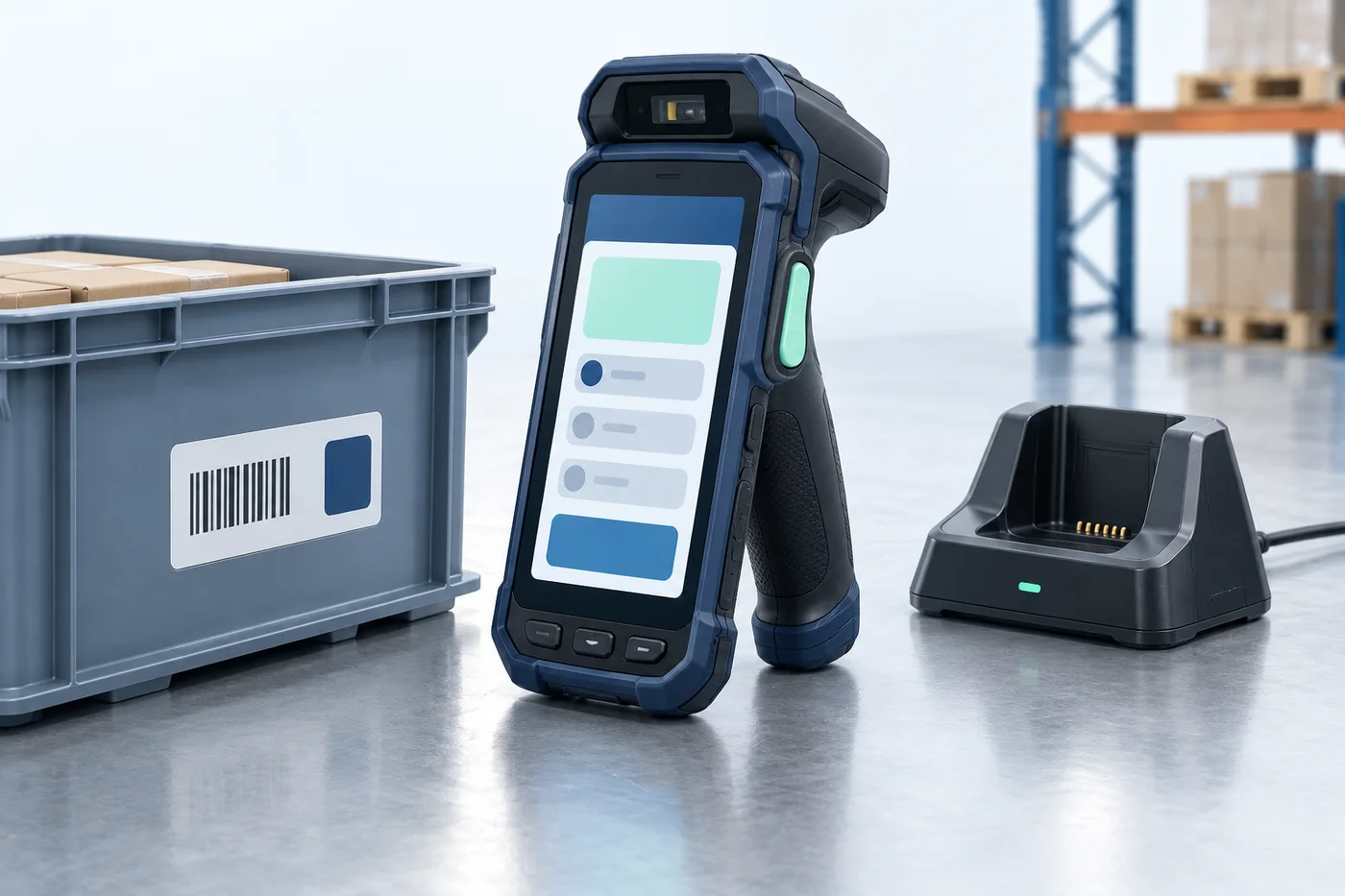
A handheld RFID reader is carried by an operator and used to read tags within its range on demand. The operator decides what to point it at and when, which makes it a directed, task-driven form of identification rather than an automatic, always-on one.
Fixed Reader Advantages
Fixed readers capture reads without operator involvement, which suits high-volume transition points such as dock doors or portals where stopping to scan individually would be impractical. Because the read zone and installation are fixed, performance at that specific location can be tuned and tested once, rather than depending on how an individual operator happens to hold a device.
Fixed Reader Limitations
A fixed reader only sees its installed read zone. It cannot search for a specific tagged item elsewhere in the facility, and its placement, antenna configuration and power settings usually require site-specific testing to get reliable, direction-aware reads without picking up tags from an adjacent lane or zone.
Handheld Advantages
A handheld reader can go to where the item is, which makes it well suited to tasks like searching for a specific asset, cycle counting a storage area, or verifying a pallet's identity at a workstation. It also gives an operator direct control over exactly what is being read, which is useful when a task requires confirming one specific item rather than capturing everything nearby.
Handheld Limitations
Handheld reading depends on an operator remembering to perform it, which reintroduces a manual step that fixed readers are meant to remove. Read range and orientation sensitivity can also make it slower for bulk tasks compared to a well-tuned fixed portal, where many tags can be captured in one pass.
Warehouse Inventory
Handheld readers are commonly used for cycle counting and inventory verification, where an operator sweeps a storage area to confirm what is present against the system record. Fixed readers are less commonly used for general inventory counting, since most storage areas are not naturally set up as a single, tunable read zone.
Gate Automation
Fixed readers are the natural fit for gate and dock-door automation, where the goal is to capture every pallet or vehicle passing through without requiring anyone to scan it manually. This is also where direction detection and read-zone tuning matter most, since a portal needs to distinguish inbound from outbound movement reliably.
Asset Search
Searching for a specific tagged asset, tool or piece of equipment is a handheld-native task: an operator moves through a likely area with the reader active until the target tag responds, which a fixed installation cannot replicate.
Receiving
Receiving can use either approach depending on layout: a fixed reader over a receiving dock can capture pallets as they are unloaded, while a handheld reader supports receiving where pallets are unloaded to varying locations that a single fixed zone would not reliably cover.
Dispatch
Dispatch verification often benefits from a fixed reader at the loading area, checking that the pallets being loaded match the expected shipment before the vehicle leaves, with a handheld reader available as a fallback where a specific pallet needs manual confirmation.
Hybrid Deployments
Most real deployments use both: fixed readers at defined, high-traffic transition points, and handheld readers for search, verification and areas that are not economical to cover with fixed infrastructure. The two feed the same underlying pallet or asset record, so the software layer, not the reader type, is what determines whether an observation is treated as a confirmed event.
Choosing Between Them
The deciding factors are usually: whether the task happens at a predictable, fixed location (favors fixed) or wherever the item happens to be (favors handheld); whether the volume justifies dedicated infrastructure and tuning (favors fixed) or is occasional enough that a shared handheld device is more practical (favors handheld); and whether the task needs to happen without operator involvement (favors fixed) or specifically needs an operator's judgment about what to read (favors handheld). Most warehouses end up using both, mapped to the tasks each is actually good at.
Related Solutions
Related Implementation Examples
Discuss your workflow
Have a Tracking or Automation Requirement?
Tell us about your current workflow and what you need to track. We can help determine the right combination of software, RFID, barcode, ANPR or other technologies.