
Manual gate registers
Arrival information may be entered late or independently of the expected visit.
Yard Automation
Create real-time visibility of vehicle movement across security gates, waiting areas, loading bays and dispatch operations.
CoEnablers can combine ANPR, RFID, GPS, sensors and workflow software depending on the level of automation required. Visibility updates as configured observations or operator confirmations reach the system.
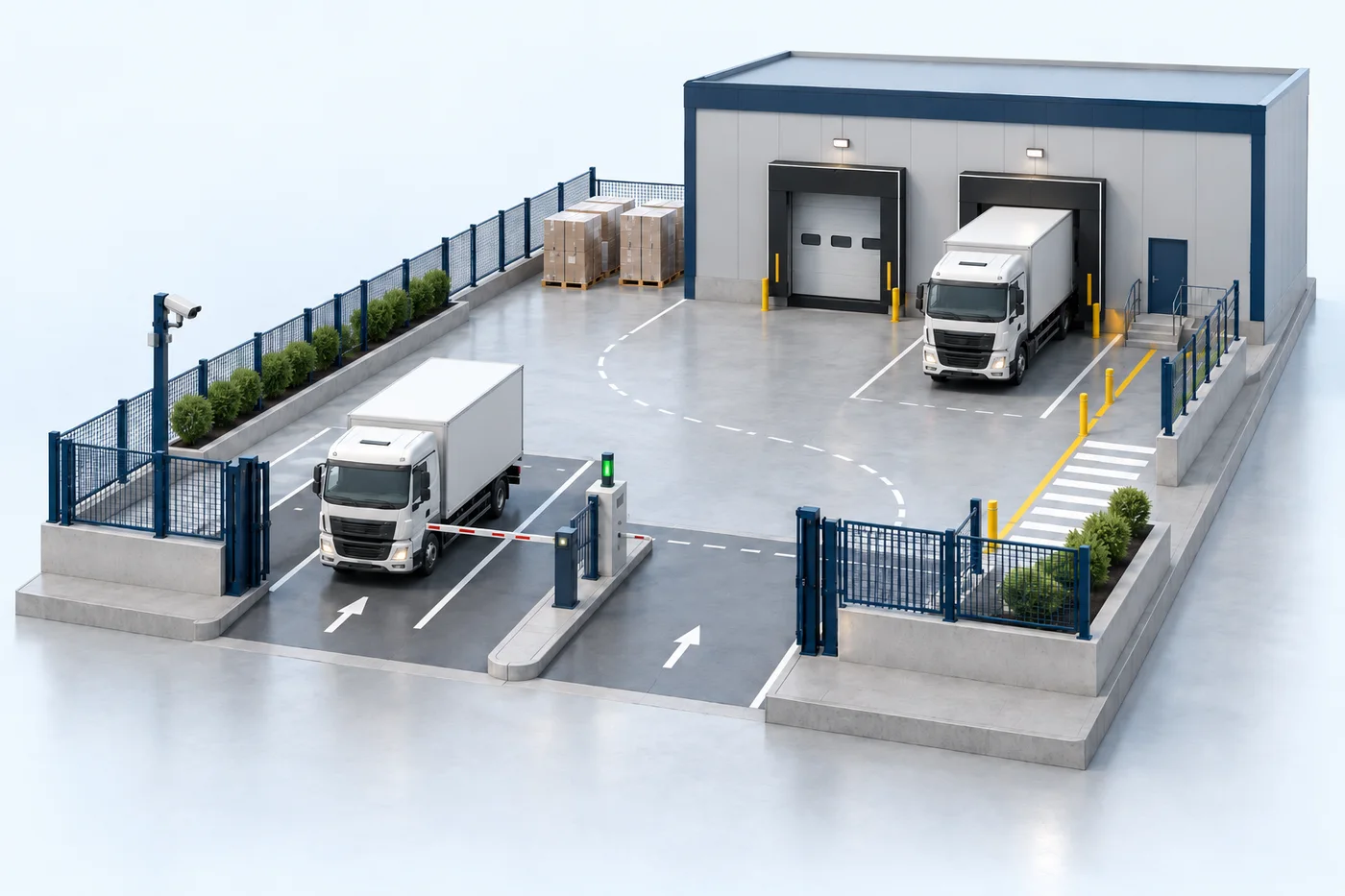
A visit with distinct stages
Vehicle journey
Identify and validate arrival.
Record waiting and service transitions.
Close the visit and review elapsed time.
A yard visit connects a vehicle's arrival to its waiting, bay and departure events. Recognition at the gate provides an identity observation; it does not explain whether the vehicle is waiting, loading or ready to leave. Those stages need their own capture points or operator confirmations.
Define a visit record that can distinguish repeated trips by the same truck. Associate it with the expected movement, relevant business references and current workflow state. That makes it possible to review where time was spent without combining unrelated visits into one history.
Real-time visibility depends on how quickly configured events arrive and are validated. An unobserved movement should remain unknown rather than being inferred as a precise position. Where infrastructure is incomplete, a clear manual or barcode confirmation can provide the missing process event.
Arrival information may be entered late or independently of the expected visit.
Recognition time, operator entry time and backend receipt time can be confused.
The visit may have no recorded transition from gate processing into the waiting yard.
Assignment and actual bay occupancy may not be visible in the same workflow.
Loading activity cannot be separated from bay dwell without defined event boundaries.
A gate observation does not establish the vehicle's current yard location.
A long total visit gives little insight without intermediate stage events.
Security, warehouse and transport systems may record separate parts of the same visit.
Each operational stage can record arrival, departure, duration and status. The capture method must be designed for that stage; the timeline does not imply automatic detection everywhere.
Create the expected visit and relevant order, transporter or appointment context.
Record the observed or confirmed arrival at the facility entrance.
Check the visit against the site's entry requirements and record the outcome.
Track the confirmed waiting state before a bay becomes available.
Associate the visit with the appropriate loading or unloading bay.
Confirm arrival at the assigned bay using available observations or an operator action.
Record task progress and its relevant start or completion confirmations.
Confirm release from the bay and preserve the departure event.
Close the physical visit after the agreed exit checks.
Calculate elapsed intervals from complete, validated event pairs.
The right architecture may combine multiple technologies. Evaluate the event needed at each point rather than expecting one device to cover the whole facility.
Technologies
Useful for automatic vehicle identification at controlled camera locations. A camera event needs lane context and validation before it changes a visit state.
Useful where vehicles can carry suitable tags and controlled reader zones can interpret a transition. Tag assignment and neighboring reads need consideration.
Useful for broader outdoor or fleet position where devices and accessible data are available. It should not be assumed to resolve every bay-level event.
May assist with presence, movement or zone detection. A presence observation needs an association with the vehicle visit before it becomes identity-aware tracking.
Useful for driver- or document-assisted confirmations and fallback tasks where an operator can identify the visit deliberately.
Associate vehicle identity with the relevant master and visit references.
Keep validated entrance and departure events in the same visit history.
Use ANPR or RFID where suitable infrastructure can identify the vehicle.
Present the latest confirmed stage and its source rather than an unsupported inferred location.
Associate the visit with a bay according to the agreed allocation workflow.
Capture the boundaries needed to understand occupancy and movement.
Calculate elapsed time between defined stage events when both are available.
Relate gate entry to gate exit for the same validated visit.
Highlight missing transitions, unexpected movement or time thresholds defined by the operation.
Retain separate visit records and their event sequence.
Connect expected and completed movement information through approved interfaces.
Summarize recorded status, incomplete visits and exceptions for operational review.
These are measurement definitions, not reported results. No example times or performance improvements are assumed.
Measure from the agreed start of gate processing to its completion. Preserve whether each boundary was observed or confirmed by an operator.
Compare entry into the waiting stage with departure toward the bay. Do not treat a missing departure event as a measured wait.
Use confirmed bay arrival and bay departure for the same visit and bay assignment.
Use actual task start and finish events where captured; bay occupancy alone may include waiting or paperwork.
Compare validated gate entry and exit timestamps. Separate incomplete visits from completed visits in the analysis.
Agree the meaning of each timestamp and the source that can create it. Camera capture time, gateway receipt time and manual confirmation time may differ. Consistent clocks and retained source metadata help teams identify delays in event delivery instead of attributing every delay to the physical process.
Define how to handle a truck that changes bays, leaves without completing a task or re-enters after exit. Corrections should preserve the original event and reason. A visit with a missing transition needs review rather than an invented duration that distorts the operational report.
Keep vehicle identity distinct from trailers, containers and movable yard equipment where those objects need their own histories. A presence sensor can indicate occupancy without identifying the load or equipment responsible. Additional association steps are necessary when those distinctions matter.
Combine visit identity with observations at the transitions that matter: entry, waiting, bay arrival, service completion and exit. ANPR, RFID, sensors or operator confirmations can supply different events. The design should make coverage gaps explicit instead of claiming a continuous position from a few checkpoints.
ANPR identifies plates at camera locations. Multiple camera points can contribute to a journey, but a gate camera alone does not track movement between those points. Additional observations or workflow confirmations are needed to establish yard status, bay arrival and departure.
Consider RFID where vehicles can carry suitable assigned tags and controlled read zones can capture the required transitions. Evaluate mounting, lane separation and unintended reads. Vehicle-to-tag association must remain current, especially when tags, tractors or trailers change.
Yes, when reliable bay arrival and departure events exist for the same visit. Measuring actual loading duration may need separate task-start and task-finish confirmations. Define those boundaries so time waiting at the bay is not automatically reported as loading time.
It can be calculated from validated entry and exit timestamps for a single visit. Missing exits, repeated observations and re-entry need clear handling. Incomplete records should be flagged rather than assigned a fabricated duration, and comparisons should use consistent event definitions.
They can provide complementary identity observations at selected points. Match each to the vehicle visit and define how disagreements are handled. A combined design still needs business validation and does not eliminate the need for a review path when a plate or tag cannot be read.
Integration can exchange expected vehicles, order references and confirmed movement events where suitable interfaces exist. Assign ownership of visit status and transaction updates, and retain downstream responses. A gate event should not automatically close an enterprise dispatch unless the agreed release conditions are met.
No. Checkpoint-based yard workflows may use ANPR, RFID, sensors and deliberate confirmations. GPS may help with outdoor or broader fleet visibility where devices and data are available, but it is not automatically the right source for every gate or loading-bay event.
Discuss your workflow
Tell us how vehicles currently enter, wait, reach bays and exit your facility. We can help map the right identification and event-capture architecture.